The operator dashboard
Camera wall, live floor plan and the incident queue.
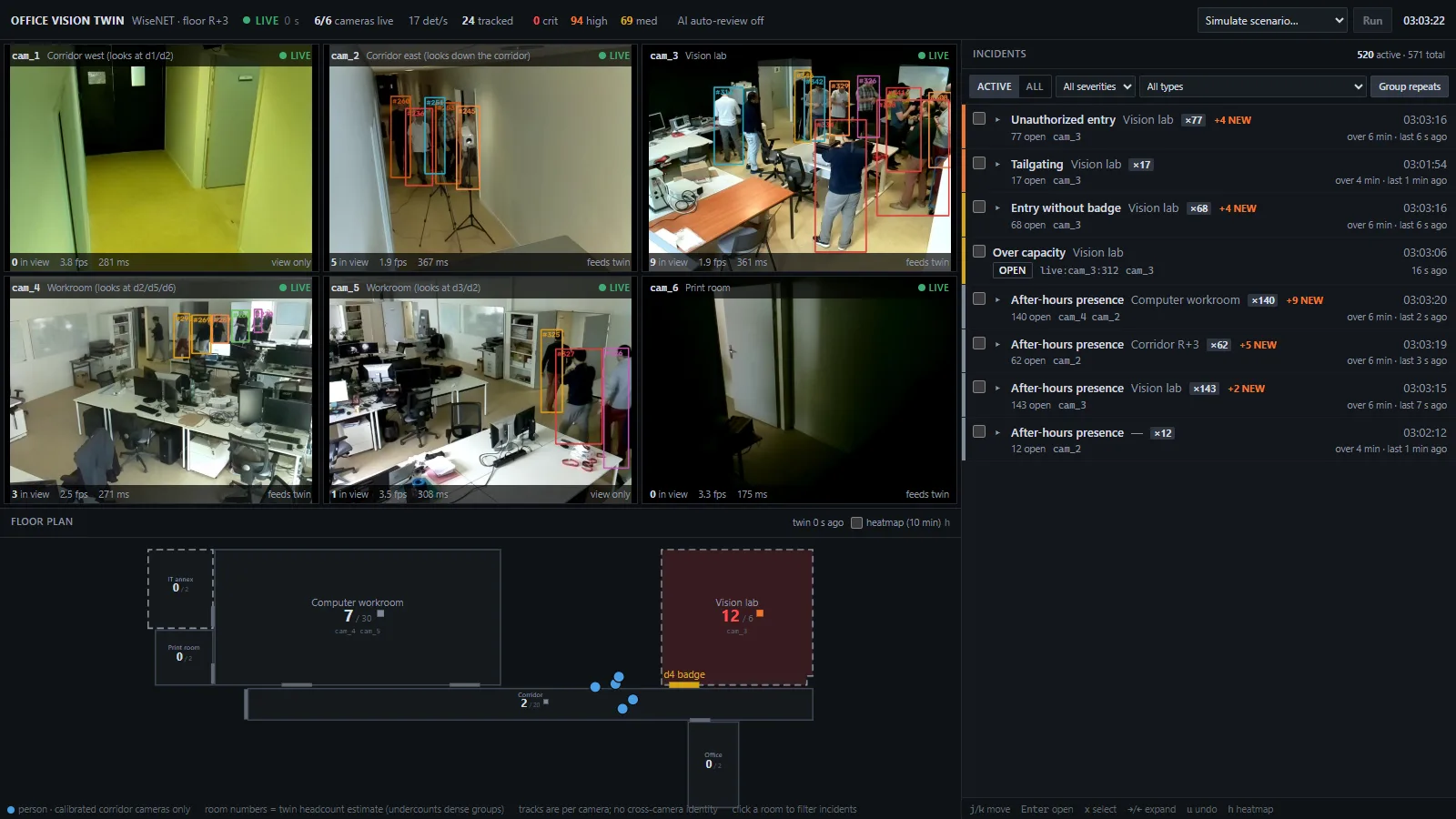
A live digital twin of a building that turns cameras and badge readers into explained, evidence-backed security incidents.
A typical security operations room has dozens of camera feeds and one or two people watching them. Human attention does not scale to a wall of screens: the moment that matters is easy to miss, and is usually found only afterwards, by scrubbing through hours of recordings.
Meanwhile the badge system knows who opened a door and the cameras know how many people walked through, but nobody connects the two. Most “AI camera” products add person detection, which moves the problem rather than solving it. The operator now has a thousand alerts a day and still has to work out what each one means.
Office Vision Twin keeps a live model of the building: its rooms and doors, who is where, and who badged in. Incidents come from explicit, testable rules over that model, not from a model’s opinion. Tailgating, for example, is more people entering through a badge door than badges were granted. Each incident carries its severity, its reason, the linked events and a clip of video.
A language model only explains. It sees one incident’s evidence packet, must cite an event ID for every claim, and a second pass rejects any claim the records do not support. The checking step is drawn below. Operators close incidents; the AI does not.
The operator dashboard shows a camera wall, a live floor plan with room headcounts, and an incident queue with severity, status and bulk triage, and it can be driven from the keyboard. Every picture shows its age, and stale data is flagged rather than shown as live.
Vision runs on premises, so video stays in the building, and the optional AI review receives text event records only. There is no face recognition. Each camera processes only its newest frame, so delay cannot build up, and slow cameras skip frames and say so.
The rules and the dashboard are covered by 313 backend tests and 33 dashboard tests. The dashboard itself is shown below.
Every figure links to the file it was drawn from.
Camera wall, live floor plan and the incident queue.
Every API route and the live push channel require authentication.
Each statement must cite an event ID, and the cited IDs are checked against the incident’s records.
Backend tests run with pytest, dashboard tests with vitest.
| Suite | Tests |
|---|---|
| Backend | 313 |
| Dashboard | 33 |
cd backend && python -m pytest tests/unit -q
cd frontend && npm testThis is a pilot-ready proof of concept, not a certified product. It uses a single access token, with no per-user accounts, roles or single sign-on yet, and runs on one node with SQLite, so there is no high availability.
People are tracked per camera, with no re-identification across cameras. It has been tested on recorded footage replayed live, including over RTSP, but not on a production camera network. The default detector is licensed AGPL-3.0, so commercial use needs a licence or a swap to a permissively licensed detector.
The source, manuals and setup scripts are on GitHub under AGPL-3.0. Status: pilot-ready POC.
The citation check from the investigator is now a standalone benchmark, groundcheck.

